
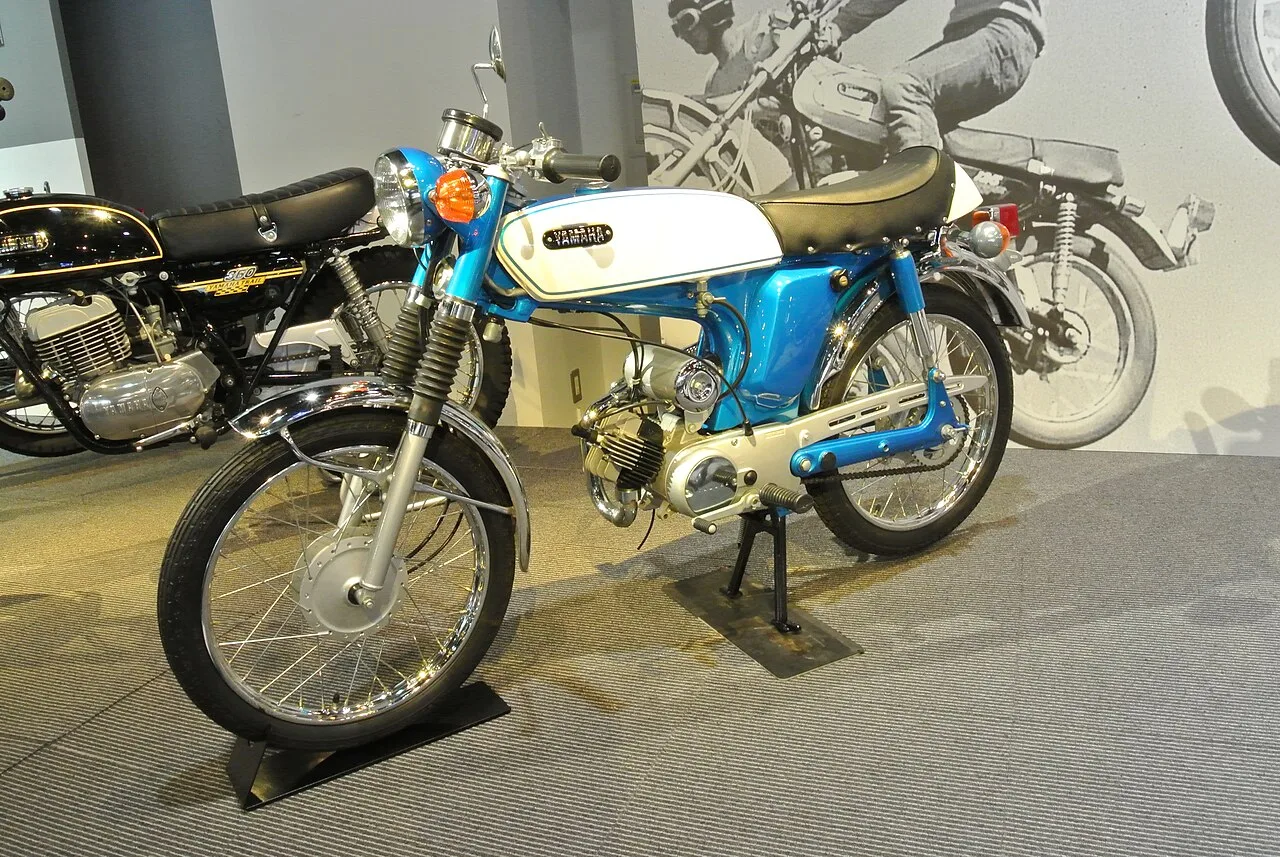
Japan, 1969: a sporting fifty with a quick engine
At the end of the sixties the small sports motorcycle was developing fast in Japan. Manufacturers competed for young buyers with machines that looked like racers and behaved like them too. Yamaha launched the FS-1 in 1969, a 50 cc road sports model that the company describes as having an over-square, high-revving, high-output engine. According to Yamaha it produced 6.0 PS at 9,000 rpm at launch, in a machine weighing 70 kilograms.
Those are the Japanese launch figures, and that is exactly where the story begins for European enthusiasts. The FS1 became a global model adapted country by country to local rules. The same basic design thus led to a family of versions with different letters, gearboxes and equipment, yet with the same recognisable silhouette.
A racer in miniature
Yamaha built the FS-1 around a pressed-steel backbone frame, a construction widely used for light motorcycles at the time. The frame carries the tank with the engine hung beneath it, giving a compact, low build. What set the FS1 apart was the styling on top: a racer-type seat, an elongated tank and straight handlebars. The result looked bold and sporty, which was precisely the intention.
That combination of a simple, strong frame and a distinctly sporting line made the FS1 attractive to a wide audience. It was light enough for novice riders yet looked like something faster. That goes a long way to explaining why it found a place in so many countries.
Engineering explained: a disc-valve two-stroke
The FS1 has an air-cooled 49 cc single-cylinder two-stroke. This engine has no camshaft with operated inlet and exhaust valves as a four-stroke does; the mixture enters the cylinder through ports and combustion takes place on every revolution. On the FS1 the intake is controlled by a rotating disc on the crankshaft. A cut-out in the disc opens the intake only at the right moment. This lets the manufacturer set intake timing independently of the piston, producing a lively engine that likes to rev.
In the workshop this means the disc, the cover it runs in and the crankcase seals are key points. A two-stroke uses the crankcase for primary compression. If a seal or gasket leaks, the mixture goes out of balance, leading to poor idling or a lean-running engine. Ignition also deserves attention: incorrect timing can make an FS1 run badly in a stubborn way. Our own 1977 FS1 DX arrived with exactly that kind of problem.
There is no single story for the electrical system and lubrication across all versions. Brakes, lubrication system, transmission and electrical equipment differ by market and version. Before applying settings or maintenance instructions, you need to know which system belongs on your machine.
Versions by market
In Europe the FS1 was adapted to each country’s moped rules. The British version received the letter E and became known as the FS1E. In the United Kingdom legislation played a major role: mopeds registered there from 1 August 1977 were limited to 30 mph (about 48 km/h). The FS1E had pedals, which could serve as footrests while riding.
The DX designation is familiar in the Low Countries. Yamaha parts documentation for 1979 distinguishes the FS1 and FS1-DX with separate model codes per country: 3F5 for Belgium, 3F2 for West Germany, 3F0 and 3F1 for Sweden and 3F4 for Norway. Workshop manuals also name designations such as FS1E-DX, FS1E-A, FS1M and FS1SE. These letters are not decoration: they refer to differences in equipment and market.
The cards below show the documented designations. They are not an exhaustive worldwide list nor a model-year overview. For your own machine, the combination of market, frame and engine numbers and the appropriate factory publication is decisive.
FS-1 (Japan)
Original Japanese road sports model with an over-square, high-revving two-stroke and pressed backbone frame.
FS1 and FS1M
Separate model designations from the workshop documentation.
FS1-DX and FS1M-DX
DX versions; listed in the factory catalogue together with the FS1, with model codes per country such as 3F5 for Belgium.
FS1E
The British version, with the letter E for that market.
FS1E-DX, FS1E-A and FS1E-DXA
Further British versions named separately in the workshop documentation.
FS1SE
A separately listed version in the workshop documentation.
Use and appeal, then and now
For many young people in the seventies the FS1 was the machine that made the world bigger. It was quick enough to impress and simple enough to work on yourself. In Britain the FS1E even earned its own nickname, the Fizzy, and in the Low Countries too the model brings back memories of a first taste of freedom on two wheels for many people.
Today the FS1 is a cherished classic precisely because it is so recognisable. The sound of a well-running disc-valve two-stroke, the light weight and the sporting line still make it an enjoyable machine. Owners who have one restored often choose not speed but that feeling from back then, with the reliability a careful rebuild can provide.
Originality and restoration choices
On an FS1, identification is not a formality. Over the years many machines have received parts from other versions or aftermarket components. A DX sticker or changed front wheel is not conclusive proof of the version in itself. Record the model code, market, frame and engine numbers and compare them with the factory publication for your market.
During a rebuild we look at crankcase sealing, crankshaft and bearings, cylinder and piston, clutch, gear selection, carburation and ignition. Establish which lubrication system belongs on your machine before applying settings. You then choose: a technical repair that keeps the existing finish, or a broader restoration that also covers bodywork and paint.
Rebuilding or restoring your Yamaha FS1
A targeted repair, engine rebuild and complete restoration each require a different scope. We first discuss the vehicle’s condition, your aims and parts availability. The project can then be defined. Original appearance, preserved patina or a different finish: make that choice before work starts.