A fifty for a new generation
For many young people a 50 cc machine was the first real step towards independence on two wheels. Honda understood this well: since the sixties it had built small sporting models that aimed to be more than transport. By the end of that decade, however, the field had changed. Rivals had developed their two-stroke engines to the point where they matched Honda’s four-stroke for peak output and acceleration. Durability and fuel economy were still on Honda’s side, but outside the café it also mattered what happened when the lights turned green.
Within Honda the call grew for a new generation of light sports machines suited to the seventies. The answer came in 1971 with the Benly CB50, announced in Japan in the spring of that year. It was not a facelift: both engine and frame were entirely new. The CB50 was meant to look like a little brother of the larger CB models that were then making their mark around the world, and it succeeded.
From Sport Cub and SS50 to CB50
The roots of Honda’s sporting fifties go back to the Sport Cub of 1960. It used an overhead-valve four-stroke single derived from the engine that had made the Super Cub so popular, with sporty styling that appealed to young buyers. In 1967 came the Benly SS50, more sharply styled and powered by the overhead-camshaft Super Cub engine. According to Honda, the SS50 was also the first in its class with a five-speed gearbox.
The SS50 shared its pressed backbone frame with the CD50 utility model. Other manufacturers also used that type of frame for their sporting fifties, but with two-stroke engines. The CB50 broke with the formula. It received a diamond-type tubular frame and a forward-inclined engine following the example of the 1970 CB90. In appearance and construction it moved clearly towards a proper motorcycle. Honda itself states that the tubular frame influenced the design of sporting fifties from other makers too.
Design and engineering explained
At the heart of the classic CB50 is an air-cooled single-cylinder four-stroke with an overhead camshaft. In a four-stroke the camshaft opens and closes the valves, and lubrication comes from oil in the crankcase rather than oil mixed into the fuel. That gives a different character from the two-strokes of the time: calmer, smoother and free of premix, but more sensitive to valve clearance, the timing drive and the condition of the oil. Owners who maintain a CB50 well find that these very qualities make it a dependable companion.
The engine is inclined forwards in the frame, as on the larger CB90. This is not just styling: it gives the machine a low, stretched line and shows off the tubular frame. The exhaust follows the CB family tradition with a downswept megaphone silencer. The long tank and the rev counter, according to Honda a first in the class, made the CB50 look more like a grown-up sports motorcycle than a moped.
A notable detail from the early years is the helmet holder. There was no helmet requirement in Japan at the time, yet Honda gave the CB50, like the CB500 Four, a helmet holder and offered colour-matched helmets as genuine accessories. The company wanted to encourage helmet use actively, through equipment as well as publicity. It shows how seriously Honda took this small model.
Development and documented versions
In Japan the CB50 grew into a family. In 1973 the Benly CB50JX was added, with a sporty seat cowl and a mechanically operated front disc brake. Mechanical matters here: the brake is cable-operated, not hydraulic. In 1976 the CB50JX-I followed, refined with a revised tank shape, seat cowl and front mudguard. Honda’s catalogue that year was full of photographs and drawings of engine parts and mechanisms, as if it described a much larger machine.
The last model of the range appeared in 1981 as the CB50S, without the Benly name. By then the CB50 had been a fixture for young Japanese riders for more than ten years. Shortly afterwards, in 1982, the water-cooled two-stroke MBX50 took over the role of sporting fifty. Much later, in 1997, the Dream 50 arrived with a DOHC four-stroke and styling recalling the racers of the sixties. Inside Honda it was also called CB50, but technically it is an entirely separate generation.
For Europe the story is less straightforward. Parts documentation shows that versions differed by market, including in gearbox and performance, with both four-speed and five-speed versions. A European CB50J is therefore not automatically identical to a Japanese CB50JX. The cards below show the versions we can substantiate; this is not an exhaustive worldwide list.
Benly CB50 (Japan, 1971)
Successor to the Benly SS50, with a new engine and tubular frame, inclined four-stroke and megaphone silencer.
Benly CB50JX (Japan, 1973)
Added to the range with a seat cowl and a mechanically operated front disc brake.
Benly CB50JX-I (Japan, 1976)
Refined with a revised tank shape, seat cowl and front mudguard.
CB50S (Japan, 1981)
Final model of the classic range, without the Benly name.
European versions
Market differences in gearbox and performance, with four-speed and five-speed versions. Japanese figures do not automatically apply to a European CB50J.
Dream 50 (1997)
A separate DOHC generation, also called CB50 within Honda. Not part of the classic CB50 parts family.
Use and appeal, then and now
In the seventies the CB50 was, for many young riders, the first machine that felt like a real motorcycle. It took them to school, work and friends, and at weekends it gave them a sense of belonging to the world of the larger CBs. Being a four-stroke meant no haze of premix and a calm, even running. Honda itself describes how the CB50 supported the motorcycling life of young people for more than a decade.
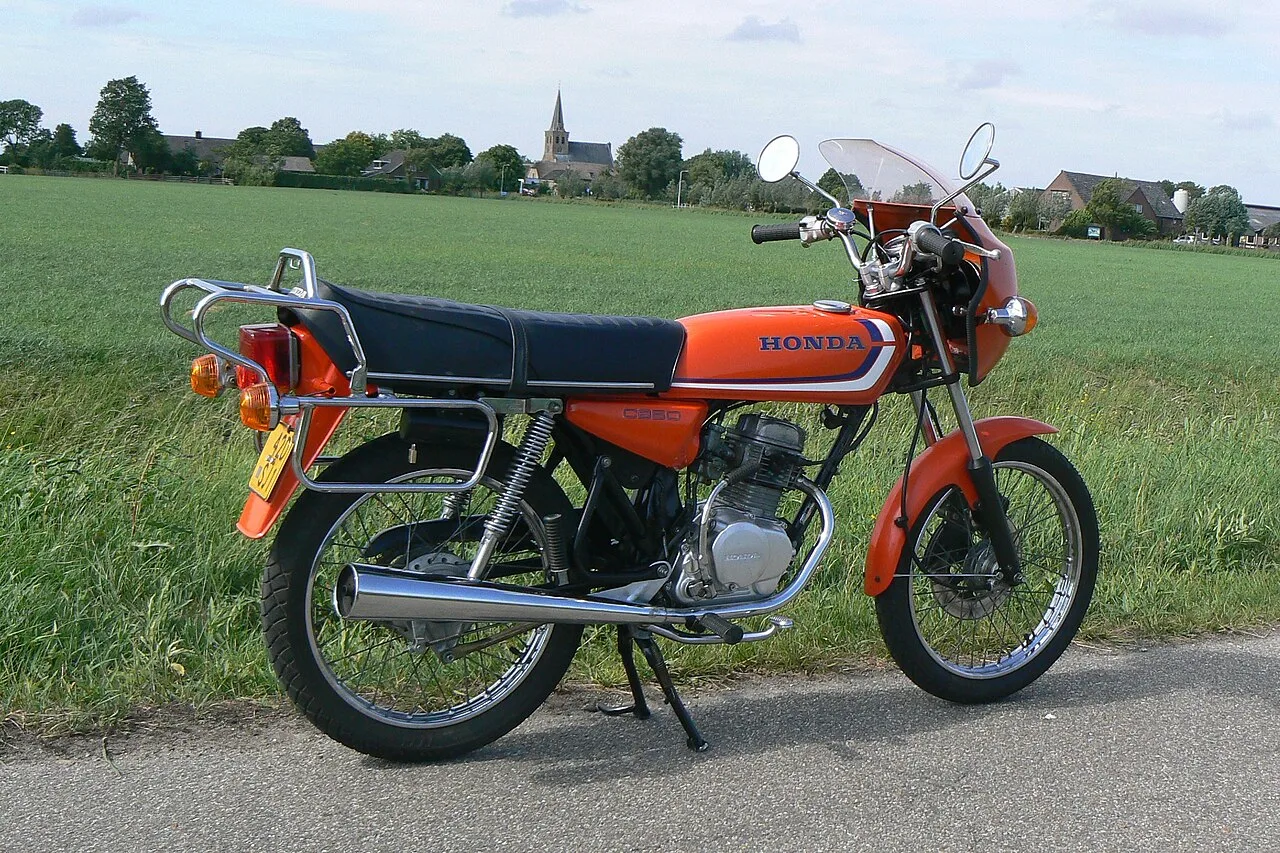
Today the CB50 appeals above all to people who lived through that era, or who want a small classic with grown-up engineering. Our own customer project, a CB50J that has been with the same owner for 46 years, shows how such a machine can become part of a life story. By modern standards it is not fast, but anyone who rides one immediately understands why it won so many young people over to motorcycling.
Originality and restoration choices
Because the CB50 existed in several markets and versions, a good restoration starts with identification. The model plate, frame and engine numbers, documents and fitted parts together tell you which version you have. A seat cowl, disc brake or tank shape alone is not conclusive. We do not simply apply Japanese performance figures or part numbers to a European CB50J, and parts from the later Dream 50 are not interchangeable on the strength of the name.
On the engine we look at valve gear and clearances, the timing drive, lubrication, cylinder and piston, carburation and ignition. On a version with a mechanical disc brake the brake operation deserves extra attention. You then choose with us: a technical rebuild that keeps the existing paint and patina, a careful refresh, or a full restoration. Each of those choices is valid, as long as it is made deliberately.
Rebuilding or restoring your Honda CB50
A targeted repair, engine rebuild and complete restoration each require a different scope. We first discuss the vehicle’s condition, your aims and parts availability. The project can then be defined. Original appearance, preserved patina or a different finish: make that choice before work starts.