MBK Booster & Yamaha BW's: overhaul, restoration and maintenance

From early BW's to the Booster NG and Spirit. Piston Classics helps you with overhauls, restorations, technical diagnosis and purchase advice for one of the most iconic scooters ever built.

Original MBK Booster / Yamaha BW's in the Piston Classics workshop
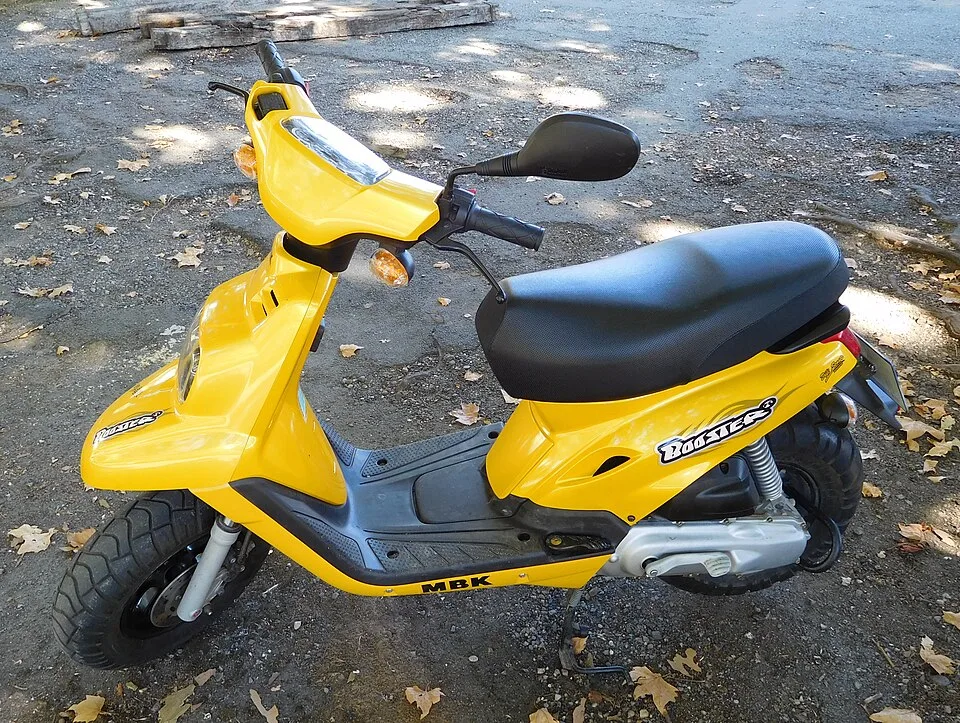
Gele MBK Booster, tweede generatie

A European icon

Few scooters have shaped a generation like the MBK Booster and the Yamaha BW's. Anyone who grew up in the late 1980s or 1990s in Belgium, France or the Netherlands knows the image: wide tyres, low seat and the unmistakable sound of a Minarelli two-stroke crawling through the streets.

Yamaha and MBK were closely intertwined at the time. MBK, formerly Motobécane, was taken over by Yamaha in 1984 and the factory in Saint-Quentin in northern France became the European production hub. Identical scooters rolled off the line under two badges: Yamaha BW's for export markets and MBK Booster for France and the Benelux.

Over three decades of production, more than two million units were built. Yet original, unmodified examples are becoming rare. Tuning culture, daily use and time all played a role. Early bikes with original paint, exhaust and decals have become genuine collector items.
The birth of the Yamaha BW's

The Yamaha BW's was designed in Japan by Yamaha's own team. The abbreviation stands for Big Wheels, a direct reference to the exceptionally wide tyres on small rims that became the model's signature.

The BW's arrived around 1989 and was an immediate success across Europe. For France and the Benelux, the group chose the MBK Booster brand, fitting within the existing dealer network of the acquired Motobécane.

The combination of wide tyres, lightweight construction and a reliable Minarelli two-stroke engine turned the scooter into a direct cultural icon. The Booster became more than transport. It became a statement, a tuning platform and a collective memory for an entire generation.

Timeline

  1. 1989

    Launch BW's / Booster first generation

    Yamaha launches the BW's with twin headlight and drum front brake. MBK releases the same scooter as Booster for France and the Benelux.

  2. 1994

    Booster R / BW's R

    Sportier version with hydraulic fork and front disc brake.

  3. 1999

    Booster Next Generation

    Completely new bodywork, larger storage and revised ergonomics. Frame codes 4BX and 4BP.

  4. 2004

    Booster Spirit

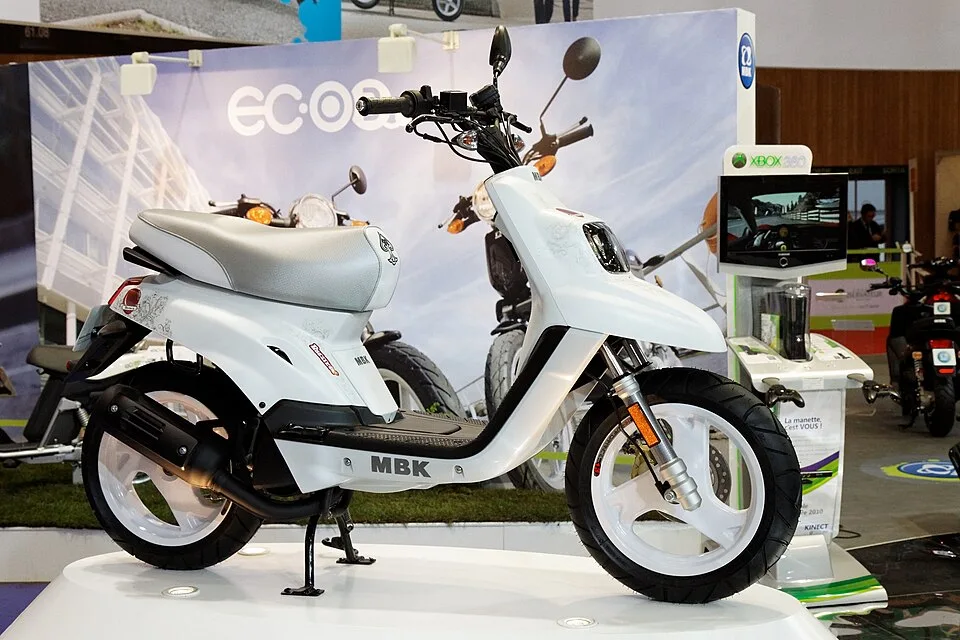
    Modernised styling, long production run. Today by far the most common Booster on the used market.

  5. 2004

    Booster Rocket / BW's Spy

    Sharper variant with adapted bodywork and sporty accents.

  6. 2009

    Booster Track / BW's Bump

    Adventure inspired styling with specific bodywork and a more upright stance.

  7. 2013

    Booster One / BW's Easy

    Retro inspired design and a return to simplicity. Accessible price point.

  8. 2018

    End of MBK

    Yamaha gradually drops the MBK brand. From 2018 onward only Yamaha branding remains.

The different generations

Over thirty years of production, MBK and Yamaha built an entire family around the same core concept. Below is an overview of the main variants, their features and typical frame codes.

First generation BW's / Booster

1989 - 1994

The original version, today the most sought-after among collectors. Recognisable by its twin headlight, lightweight body design and drum brake on the front wheel.

Typical frame numbers start with 3AA. Original bodywork, decals and exhausts are increasingly difficult to source.

Foto volgt

Booster R / BW's R

from 1994

Sportier version with technical upgrades. Hydraulic telescopic fork replaces the simple original design, and a front disc brake replaces the drum.

The R version rides and stops better. Ideal for those who want the first generation look with more modern safety.

Foto volgt

Booster Next Generation (NG)

1999 - 2004

Completely new bodywork that took the Booster concept into a new generation. Larger storage and revised ergonomics.

Typical frame numbers are 4BX and 4BP. Many enthusiasts confuse early NG models with first generation models due to the similar silhouette.

Foto volgt

Booster Rocket / BW's Spy

from 2004

A sharper variant within the NG family. Modified bodywork and aggressive graphics. Mechanically identical to the standard NG.

For export markets the same version was sold as the BW's Spy.

Foto volgt

Booster Spirit

2004 - 2017

Modernised styling on the NG platform. The Spirit had an exceptionally long production run and is by far the most common Booster on the market today.

Later years received updates to electrics, emissions and brakes. Excellent choice for daily use.

Foto volgt

Booster Track / BW's Bump

from 2009

Adventure inspired variant with specific bodywork and a higher riding position. Mechanically a normal Booster but visually distinct.

Good for those who want a strong character with a light off-road feel.

Foto volgt

Booster 100

1999 - 2003

The 100 cc version, developed for markets where this displacement was fiscally attractive. Stronger performance and more comfortable cruising speed.

Today highly sought after on the collector market. Original Booster 100 examples are rare and values rise year on year.

Foto volgt

Booster Spirit 12 inch

from 2007

A Spirit variant with 12 inch wheels instead of the usual 10 inch. Stability improves, especially on poor roads.

A good compromise between the iconic Booster character and the comfort of a more conventional scooter.

Foto volgt

Booster One / BW's Easy

from 2013

Introduced in 2013 as a retro inspired version. Simpler equipment and an accessible price.

Today an affordable entry point for a recent Booster with a retro twist.

Foto volgt

End of MBK

2018

From 2018 Yamaha gradually phases out the MBK brand. Boosters built afterwards in Saint-Quentin only carry Yamaha branding.

For collectors this marks the end of an era.

Foto volgt

Why did the Booster become so popular?

The Booster and BW's success is no accident. A combination of deliberate design choices made it the ideal product for the European market of the late 1980s and 1990s.

Wide tyres

The signature feature. Wide tyres on small rims provide both grip and visual presence.

Lightweight construction

A light frame and bodywork keep the scooter agile and let the Minarelli engine perform at its best.

Reliable Minarelli engine

A simple, well thought out and almost indestructible engine that is easy to maintain.

Excellent handling

Short wheelbase and low centre of gravity make the Booster remarkably agile in city traffic.

Huge parts market

Both original and aftermarket parts remain widely available, keeping restorations practical.

Easy maintenance

The technical layout is logical and accessible. Much of the work can be done with basic tools.

Massive tuning scene

No other scooter has seen as many cylinder kits, exhausts and cosmetic parts as the Booster.

The legendary Minarelli engine

At the heart of every Booster and BW's is the Minarelli two-stroke engine, air-cooled and paired with a variomatic transmission. It is a design that has been proving for decades that simplicity and robustness form the best foundation for long life.

The engine has a vertical cylinder and a fairly compact build. The variator provides stepless transmission without shifting. The crankshaft runs on ball bearings, with seals separating crankcase and gearbox.

Maintenance remains surprisingly simple. Periodic checks of spark plug, mixture, air filter and variator rollers are enough in most cases. Typical wear points to monitor are crankshaft seals, variator rollers and clutch shoes.

A well maintained engine can cover tens of thousands of kilometres. A proper overhaul every five to ten years keeps the Booster at its best.

Technische illustratie volgt

Common problems

Experience with dozens of Boosters and BW's shows that the same issues keep coming back. Below are the most common, each with a short technical explanation.

Hard starting+

Usually a combination of weak spark, dirty carburettor and slight loss of compression. Start with the spark plug, then the carburettor and compression test.

Loss of compression+

Caused by worn piston rings, scoring in the cylinder or a leaking head gasket. A compression test gives an immediate answer.

Carburettor problems+

Blocked jets from old fuel, a stuck float or worn float needle. A thorough ultrasonic cleaning solves most cases.

False air+

A classic two-stroke problem. Unwanted air enters through worn crankshaft seals or a leaking intake. A smoke test locates the leak.

Electrical faults+

Oxidised connectors, failing fuse holders and worn ignition coils are the classics. A full circuit measurement identifies the weak spots.

Worn variator+

Worn or flat-spotted rollers cause hesitant acceleration. Replacement with an original roller set restores correct behaviour.

Worn seals+

Crankshaft seals are crucial. Symptoms include hard starting, uneven running and blue smoke. Requires engine teardown.

Loss of power+

A combination of multiple causes. Start with a visual inspection of exhaust, air filter and carburettor.

Restoring an MBK Booster

A correct restoration always follows the same logical steps. At Piston Classics we work to a fixed protocol refined across dozens of Booster and BW's projects.

  1. 1

    Complete teardown

    Bodywork, engine, transmission, fork, brakes and electrics are stripped down to the bare frame. Every part is labelled and photographed.

  2. 2

    Frame inspection

    The bare frame is checked for cracks, deformation and previous welds. The frame number is photographed.

  3. 3

    Engine overhaul

    Cylinder, piston, rings, crankshaft and bearings are measured. Seals, gaskets and bolts are renewed as a matter of course.

  4. 4

    Transmission overhaul

    Full variomatic disassembly. Rollers, sliders, clutch shoes and drive belt are checked or replaced.

  5. 5

    Fork overhaul

    Fork stripped, seals and oil replaced. For hydraulic forks the correct viscosity is used as specified by MBK.

  6. 6

    Brake overhaul

    New pads, piston inspection. Brake fluid replaced according to recommendations.

  7. 7

    Electrical install

    Complete loom checked. Connectors cleaned or replaced. Full circuit measurement at the end.

  8. 8

    Paintwork

    Bodywork stripped, checked and prepared. Paint applied to the original MBK colour codes. Original decals reused where possible.

  9. 9

    Assembly

    Reassembled in correct sequence with all bolts to the specified torque. Wiring carefully routed.

  10. 10

    Road testing

    No restoration leaves the workshop without extensive testing. First cold and short, then longer at temperature. Final adjustments follow.

Value of an original Booster

The value of a Booster or BW's is today determined by a limited set of criteria. Knowing them allows a fair assessment of any scooter on the collector market.

Original paint

First paint, free of overspray or touch-ups, significantly raises value.

Original exhaust

Original exhausts in good condition have become rare.

Low mileage

Low and verifiable mileage makes a real difference to collectors.

Documentation

Original papers, service books and invoices represent meaningful added value.

Accessories

Original MBK or Yamaha accessories like top boxes and screens raise value.

Original decals

Never resprayed and with intact original stickers, a Booster becomes immediately more interesting.

Frame numbers

Matching numbers between engine and frame, and clearly legible frame numbers, are essential.

Collector demand

First generation and Booster 100 rise fastest. The Spirit remains sought after for daily use.

Value comparison by model

ModelProductionRarityIndicative valueNotes
First generation BW's / Booster1989 - 1994HighStrongly risingThe collector model par excellence.
Booster NG1999 - 2004MediumRisingFrames 4BX and 4BP. Often confused with first generation models.
Booster Spirit2004 - 2017LowStableMost common model. Good entry point for daily use.
Booster 1001999 - 2003Very highStrongly rising100 cc version. Limited production. Highly sought after today.

Why are original examples rare?

The Booster was mass produced, but the vast majority has been modified, damaged or worn out over the years.

The tuning culture around the Booster was overwhelming. Cylinder kits, sports exhausts, alternative variators and modified bodywork became almost standard.

On top of that, the Booster was widely used as daily transport by 15 to 25 year olds. Crashes, poor maintenance and neglect were the rule rather than the exception.

Poor restorations also weigh on the market. A Booster with wrong decals, wrong colours or non-original exhausts loses value sharply.

Restoration and overhaul at Piston Classics

At Piston Classics we have been working on Boosters and BW's of every generation for years. Our approach always starts from respect for the scooter's originality.

Full restorations

From first teardown to final road test. Includes frame, engine, transmission, paint and electrics.

Engine rebuilds

Complete overhaul of the Minarelli engine with original or recognised replacement parts.

Carburettor overhauls

Disassembly, ultrasonic cleaning, gasket replacement and proper bench setup.

Electrical diagnosis

Full circuit measurement, fault tracing and loom repair.

Technical inspections

Preparation for official roadworthiness checks and classic registration.

Purchase advice

Independent evaluation of a Booster or BW's before purchase. Avoids expensive mistakes.

Parts sourcing

We have an extensive network for original and rare Booster parts.

Available Boosters and BW's

We currently have no Booster or BW's in stock. Get in touch to share your requirements.

Frequently asked questions

What is the difference between a Booster and a BW's?+

Mechanically none. Both models were built in the same Saint-Quentin factory with the same engine, frame and parts. The only difference is brand and stickers.

What does NG mean?+

NG stands for Next Generation, the second major generation of the Booster, introduced in 1999 with all-new bodywork and revised ergonomics.

What does 3AA mean?+

3AA is the typical frame number prefix of the first generation BW's and Booster, built between 1989 and 1994.

What does 4BX mean?+

4BX is one of the frame number codes of the Booster Next Generation, identifying specific production years and versions.

What does 4BP mean?+

4BP is another frame number code within the NG family. The exact combination of letters and numbers determines year and version.

What is a Booster Spirit?+

The modernised version of the NG, produced from 2004 to 2017. The long production run makes it by far the most common Booster today.

What is a Booster Rocket?+

A sportier variant within the NG family with modified bodywork and aggressive graphics. Mechanically identical to the standard NG. Sold for export as the BW's Spy.

Which Booster has the highest collector value?+

First generation BW's and Booster from 1989 to 1994, followed by the rare Booster 100. Originality, low mileage and complete documentation always make the difference.

Which engine powers the Booster?+

An air-cooled Minarelli two-stroke with variomatic transmission. The core design was retained across the generations.

Are parts still available?+

Yes. The Booster was mass produced, so the market for original and aftermarket parts is still well supplied.

How much does a restoration cost?+

A full restoration is typically between three and six thousand euro, depending on starting condition and parts availability.

How can I recognise a first generation Booster?+

By the twin headlight, the drum front brake and the lighter body design. First generation frame numbers start with 3AA.

What is an original Booster worth?+

A first generation BW's or Booster in original condition with low mileage can fetch between two and four thousand euro.

Is a Booster reliable?+

With proper maintenance, certainly. The Minarelli engine is simple and robust. Every two-stroke needs periodic attention to variator, seals and carburettor.

Can a Booster still be used daily?+

Yes, provided the scooter is in good technical condition. A Booster Spirit from after 2004 is generally the most practical model for daily commuting.

Discover more